
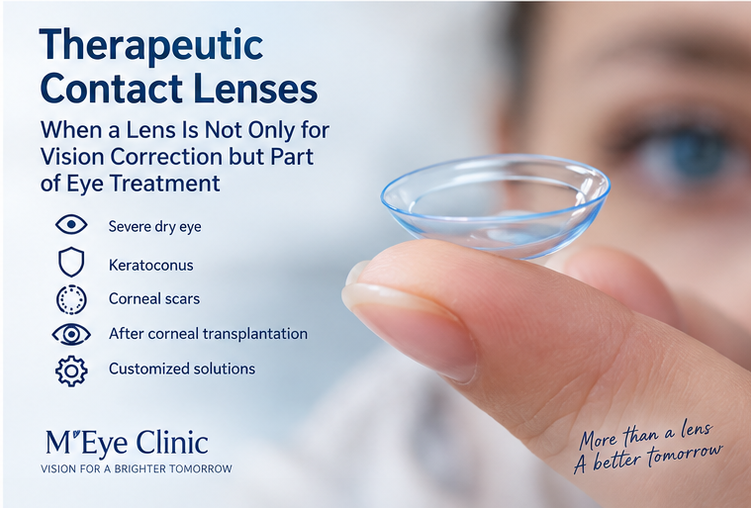
When most people hear the words “contact lenses”, they think of an alternative to glasses. A lens that corrects the prescription, improves sharpness and allows the patient to function without glasses during the day.
But in complex eye care, contact lenses can be much more than that. In selected cases, a lens is not only an optical correction. It can become part of the treatment, protection and rehabilitation of the eye. These are therapeutic contact lenses.
This does not refer to a regular off-the-shelf lens. It refers to a lens selected and fitted according to the condition of the cornea, the ocular surface, the tear film, the medical history, visual quality and patient comfort.
What are therapeutic contact lenses?
Therapeutic contact lenses are lenses designed to address a medical or functional eye condition, not only to correct a prescription. They may help when the eye needs protection, better visual quality, reduced friction, a more stable optical surface or improved function despite an ocular surface problem.
In some cases, the lens may be a soft therapeutic lens. In others, it may be a rigid lens, a scleral lens or a custom-designed specialty lens.
What they have in common is that the goal is not simply “to see without glasses”. The goal is to address a deeper need of the eye.
In which situations can a lens be therapeutic?
Therapeutic lenses may be relevant in different situations, including:
- severe dry eye
- keratoconus
- corneal scars
- irregular cornea
- after corneal transplant
- after eye surgery
- after laser surgery that did not give a good result
- corneal injuries
- high sensitivity to regular lenses
- poor visual quality despite glasses
In each of these situations, the question is not only what prescription is needed. It is what lens design can create a better environment for the eye and for vision.
How can a lens protect the cornea?
When the cornea is sensitive, injured or irregular, direct contact, dryness or friction may worsen discomfort. A therapeutic lens may, in selected cases, create a protective layer between the eyelid and the cornea, or provide a more stable optical surface.
For example, scleral lenses do not sit directly on the central cornea. They rest on the white part of the eye and create a fluid layer over the cornea. In suitable cases, this fluid layer may help both comfort and visual quality.
Severe dry eye and therapeutic lenses
Dry eye can make any regular lens intolerable. But in some cases, a specialty lens may help when it is fitted correctly.
When the eye is very dry, the goal is not only to add moisture. The clinician needs to understand the tear film, whether inflammation is present, whether the eyelids are involved, whether the cornea has been affected and whether the eye needs a lens that creates a more stable environment on its surface. Patients with significant symptoms can also learn more about dry eyes treatment and how M’Eye Clinic evaluates the ocular surface.
Keratoconus and therapeutic lenses
In keratoconus, the cornea does not maintain a symmetrical shape. Glasses may therefore stop being enough, even when the prescription seems accurate. In these cases, specialty lenses may not only improve visual acuity, but also create a new and more regular optical surface.
That is why therapeutic lenses in keratoconus are not simply “lenses with a prescription”. They are part of visual rehabilitation. If keratoconus has been diagnosed, the Keratoconus Treatment page explains the condition and the clinical approach in more detail.
Corneal scars and poor visual quality
A corneal scar can scatter light, cause glare, halos and an image that does not feel clean. In these cases, glasses may not be able to correct the distortion created by the cornea.
A therapeutic or scleral lens may sometimes help by creating a smoother optical surface over the cornea. This does not mean that every scar is suitable for a lens, or that a perfect result is always possible, but it is often worth evaluating. For a deeper discussion of this issue, see the article Corneal Scars and HOA: Restoring Vision with Advanced Lens Corrections.
After corneal transplant or eye surgery
Patients after corneal transplant or eye surgery may deal with an irregular cornea, high astigmatism, dryness, sensitivity or difficulty reaching good vision with glasses. In these cases, fitting a regular lens may not be enough.
A therapeutic lens must take into account the new corneal structure, eye sensitivity, clearance from the cornea and long-term comfort. For related information, see lenses after corneal transplant.
Why professional fitting is so important
With therapeutic lenses, fitting is not a technical detail. It is the heart of the process. A lens that does not sit correctly may cause pressure, fogging, discomfort, bubbles or unstable vision.
A good fitting process should evaluate:
- how the lens sits on the eye
- whether there is unwanted corneal touch
- whether the fluid reservoir is appropriate
- whether vision remains stable during the day
- whether the patient can insert and remove the lens safely
- whether adjustments are needed after a trial period
This is also why advanced technologies may sometimes be needed. In highly complex optical cases, M’Eye Clinic may consider specialty designs and, where relevant, concepts related to HOA-guided scleral lenses.
How do you know if you need a therapeutic lens?
It is worth considering an evaluation when:
- regular lenses are uncomfortable
- dry eye is severe
- keratoconus or an irregular cornea is present
- there is a corneal scar
- you had a corneal transplant
- laser surgery did not provide the expected result
- glasses do not provide clean vision
- there is glare, halos or unstable vision
The goal of the evaluation is not to sell a lens. It is to understand whether a therapeutic lens is truly appropriate for the condition of the eye.
How M’Eye Clinic approaches therapeutic contact lenses
At M’Eye Clinic in Jerusalem, Israel, a therapeutic lens is not treated as a shelf product. The fitting begins with understanding the eye: the cornea, tears, medical history, comfort, visual quality and previous lens experience.
In suitable cases, the clinic evaluates whether scleral lenses, specialty lenses or an advanced fitting method can provide a better solution than what has been tried before.
This approach is especially relevant for complex patients from Israel and across the Middle East who have already tried standard glasses or lenses but still struggle with comfort or visual quality.
FAQ
Are therapeutic contact lenses the same as regular contact lenses?
No. Therapeutic lenses are designed to address a medical or functional eye condition, not only to correct a prescription.
Are scleral lenses therapeutic lenses?
In many cases, yes. They can be used in severe dry eye, keratoconus, irregular cornea or post-surgical eyes when fitted correctly.
Does every dry eye patient need therapeutic lenses?
No. Most dry eye cases do not require specialty lenses. But in severe dry eye or after failure of standard solutions, this option may be worth evaluating.
Can a therapeutic lens improve vision?
In selected cases, yes, especially when the problem is an irregular cornea, a corneal scar or keratoconus. The goal is to create a more stable optical surface.
Can I know on my own which lens is right for me?
No. Therapeutic lens fitting requires a professional exam, experience and follow-up.
Summary
Therapeutic contact lenses are not just another product on the shelf. In cases of severe dry eye, keratoconus, corneal scars, irregular corneas or post-surgical eyes, a lens may become part of the treatment and rehabilitation of the eye.
The key difference is not only the type of lens. It is the fitting. When the real needs of the eye are understood, the chosen solution can support vision, comfort and protection of the ocular surface.