
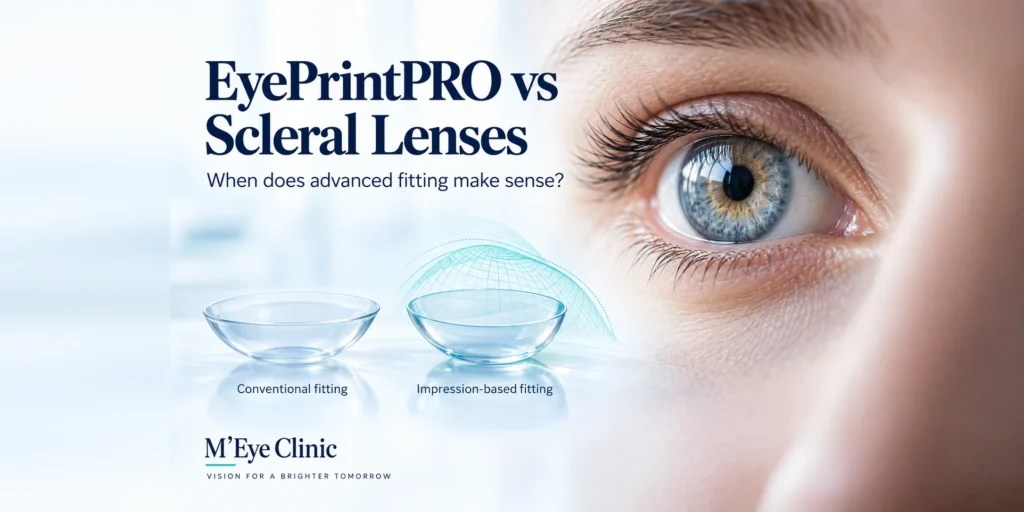
Scleral lenses are already highly customized compared with ordinary contact lenses.
So when patients hear about EyePrintPRO, one question comes up immediately:
If scleral lenses are custom-made anyway, what is actually different?
The answer is that conventional scleral fitting and impression-based fitting do not begin from exactly the same information.
A conventional scleral lens is selected and modified using clinical measurements, diagnostic lenses and observation of how the lens behaves on the eye.
EyePrintPRO takes customization further by creating a detailed impression of the ocular surface and using that shape to design a lens around the individual anatomy.
That difference becomes most relevant when the eye itself is unusually complex.
Conventional scleral lenses already offer significant customization
A standard scleral fitting is not the same as buying a regular contact lens.
The clinician evaluates the cornea, sclera, tear reservoir, landing zone, lens stability and visual response.
Adjustments can be made to diameter, vault, power and other design parameters.
For many patients with keratoconus, irregular corneas or dry eye, this approach can provide excellent vision and comfort.
Our guide to scleral lenses for keratoconus explains why the fluid reservoir and optical surface can make such a major difference.
So what does EyePrintPRO add?
EyePrintPRO is designed for cases where the anatomy of the ocular surface is difficult to reproduce accurately with conventional trial fitting alone.
Instead of relying only on standard diagnostic lens geometry, the fitting process captures the three-dimensional contour of the eye's surface.
The final lens can then be designed to match that anatomy more closely.
The goal is not to make every scleral lens patient use EyePrintPRO.
The goal is to have another option when conventional fitting does not provide enough control.
When can the difference matter?
Some eyes have relatively predictable anatomy.
Others do not.
A patient may have asymmetric scleral shape, scars, surgical changes, elevations such as pinguecula, unusual conjunctival anatomy or a previous history of lenses that repeatedly caused pressure or instability.
In these situations, a lens can provide good vision in the examination room but still become uncomfortable several hours later.
Another patient may have gone through several scleral designs without reaching stable wearing time.
This is where a more individualized approach may become relevant.
EyePrintPRO after previous scleral lens failure
A previous failure with scleral lenses does not automatically mean the patient cannot wear scleral lenses.
The reason for failure is more important than the fact that failure occurred.
Common problems can include:
- localized pressure or redness
- lens instability
- persistent bubbles
- repeated fogging
- difficult removal
- poor wearing time
- unusual scleral anatomy
- good comfort but disappointing visual quality
Some of these issues can be solved by modifying a conventional lens.
Others may require a more customized design.
For patients trying to understand why a previous fitting did not succeed, our article on what makes a scleral lens fitting successful explains why lens design, ocular anatomy and follow-up all matter.
Is EyePrintPRO better than a regular scleral lens?
Not automatically.
"More advanced" does not mean "necessary for everyone."
If a conventional scleral lens fits well, remains comfortable and provides stable functional vision, there may be no reason to move to an impression-based design.
EyePrintPRO becomes more relevant when there is a specific fitting problem that requires additional customization.
This distinction is important because the goal is not to use the most complicated technology.
The goal is to use the right technology for the eye.
What about keratoconus?
Many keratoconus patients can do very well with conventional scleral lenses.
The main corneal irregularity is often successfully neutralized by the fluid reservoir and the front optical surface of the lens.
However, some keratoconus patients also have complex scleral anatomy, previous surgery, scarring or repeated fitting failures.
In these cases the fitting problem may extend beyond the cornea itself.
That is when additional customization may be considered.
What about corneal transplant patients?
Post-transplant eyes can be especially complex.
The cornea may have irregular astigmatism, graft-host junction changes and optical distortion, while the surrounding ocular surface may also have undergone anatomical changes.
A conventional scleral lens may still work very well.
But in selected cases, highly customized fitting can become useful when the eye does not behave predictably with standard designs.
For more information, see specialty lenses after corneal transplant.
Does EyePrintPRO automatically provide better vision?
No.
Fit and optics are related, but they are not the same thing.
A lens can match the eye extremely well and still leave the patient with halos, glare or other visual-quality complaints caused by more complex optical aberrations.
That is why some patients may need evaluation beyond the mechanical fit.
In selected cases, HOA-related or wavefront-guided approaches may become relevant once the lens is stable.
What is the main advantage of impression-based fitting?
The main advantage is anatomical customization.
When the ocular surface is highly asymmetric or when a standard landing zone repeatedly creates pressure, instability or discomfort, an impression-based design can give the clinician more detailed information about the eye.
This can be especially useful when the challenge is not simply the prescription, but the physical relationship between the lens and the ocular surface.
Who may be a good candidate?
EyePrintPRO may be considered in selected patients who have:
- failed multiple scleral lens designs
- highly irregular scleral anatomy
- post-surgical ocular surface changes
- localized elevations or scars
- pressure points with conventional lenses
- persistent instability
- complex corneal disease combined with fitting difficulty
Suitability still requires professional evaluation.
EyePrintPRO at M'Eye Clinic in Jerusalem, Israel
M'Eye Clinic in Jerusalem works with complex corneal and specialty contact lens cases, including patients who have already tried conventional solutions.
For these patients, the clinical question is not simply whether EyePrintPRO is "better."
The question is whether the eye has an anatomical or fitting problem that justifies a different level of customization.
Wondering whether your eye needs impression-based fitting? Leave your details below and we will get back to you.
Patients also reach the clinic from Israel and from other countries in the Middle East when they require evaluation for complex scleral lens fitting, irregular corneas or advanced optical rehabilitation.
FAQ
Is EyePrintPRO the same as a scleral lens?
EyePrintPRO produces a highly customized prosthetic scleral device designed from an impression of the ocular surface. It belongs to the broader family of scleral-type specialty lenses but uses a different fitting approach.
Does everyone who needs scleral lenses need EyePrintPRO?
No. Many patients achieve excellent results with conventional scleral lenses.
Is EyePrintPRO useful after failed scleral lenses?
It may be considered when previous failure was related to anatomy, pressure, instability or insufficient customization.
Can EyePrintPRO be used for keratoconus?
In selected cases, yes, particularly when keratoconus is combined with complex fitting challenges.
Can EyePrintPRO correct HOA?
Mechanical customization and HOA correction are different concepts. Some complex patients may require additional optical strategies after a stable lens fit has been achieved.
How do I know whether conventional scleral lenses or EyePrintPRO are more appropriate?
The decision depends on the cornea, sclera, ocular surface, previous lens history, comfort and visual goals.
Final Thoughts
Conventional scleral lenses and EyePrintPRO should not be viewed as competing products.
They are different levels of customization within the same broader goal: creating a stable, comfortable optical system for a complex eye.
For many patients, conventional scleral fitting is more than sufficient.
For selected patients with unusual anatomy, repeated fitting failure or significant pressure and stability problems, impression-based fitting may provide another path when standard approaches have reached their limit.