
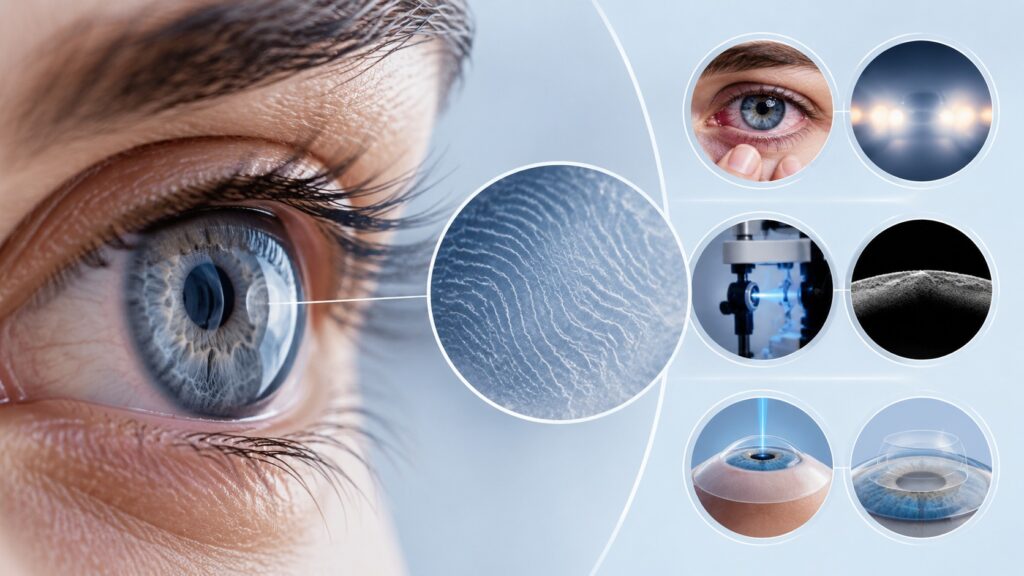
EBMD, or Epithelial Basement Membrane Dystrophy, is one of the most common corneal surface conditions that many patients have never heard of. It is also known as Map-Dot-Fingerprint dystrophy because of the characteristic patterns that can appear on the cornea during examination. For some people it causes only mild symptoms, but for others it can lead to unstable vision, recurrent pain, severe morning discomfort, dry eye complaints and repeated frustration with glasses or contact lenses.
The important point is simple: EBMD is not only a “surface irritation.” It can affect the way the corneal epithelium attaches to the underlying layer. When that attachment is weak or irregular, the optical surface of the eye may become unstable. The result can be blurred or fluctuating vision even when the prescription seems correct.
What is EBMD?
In a healthy cornea, the outer epithelial cells attach smoothly and securely to the basement membrane. In EBMD, this basement membrane develops abnormally. Instead of creating a regular, stable surface, it may form subtle ridges, dots, map-like areas or fingerprint-like lines. These changes can interfere with comfort and visual clarity.
Many patients do not receive a clear explanation at first because EBMD can mimic other conditions. It may look like dry eye, a recurrent abrasion, poor contact lens tolerance, or simply “vision that keeps changing.”
Common symptoms of EBMD
- Blurred or fluctuating vision
- A gritty or foreign-body sensation
- Pain when waking up in the morning
- Light sensitivity
- Recurrent corneal erosions
- Dry eye symptoms that do not fully respond to basic treatment
- Difficulty achieving stable vision with glasses or regular contact lenses
One of the classic patterns is pain on waking. During sleep, the eyelid may adhere slightly to an unstable epithelial surface. When the eye opens in the morning, the fragile layer can pull or tear, creating sharp pain and irritation.
How EBMD is diagnosed
Diagnosis usually begins with careful slit-lamp examination. In many cases, the map-dot-fingerprint pattern can be seen by an experienced clinician. Additional evaluation may include corneal topography, ocular surface assessment and examination of tear film stability. The goal is not only to identify EBMD, but to understand whether it is causing pain, visual fluctuation, recurrent erosions or poor lens tolerance.
Treatment options for EBMD
Treatment depends on severity. Mild cases may be managed with lubrication, ointments at night, hypertonic saline or surface care. More persistent cases may require medical procedures such as epithelial debridement or phototherapeutic keratectomy, depending on the ophthalmologist’s evaluation.
For patients whose main problem is optical instability or ocular surface discomfort, specialty contact lenses may become relevant. This is where scleral lenses can be helpful in selected cases. Because they vault over the cornea and create a fluid reservoir between the lens and the eye, they can provide a smoother optical surface and protect the corneal surface during the day.
How scleral lenses may help EBMD patients
Scleral lenses do not “cure” EBMD. However, they can help some patients function better by reducing friction, improving optical stability and maintaining a hydrated environment over the cornea. This can be especially relevant when EBMD is associated with dry eye symptoms, irregular vision or discomfort with standard contact lenses.
The key is proper fitting. A patient with EBMD needs more than a standard lens trial. The clinician must assess the corneal surface, tear film, lens clearance, comfort and visual quality over time.
When should EBMD patients seek advanced evaluation?
If you have repeated corneal erosions, morning pain, unstable vision, or dry eye symptoms that do not improve with routine care, a deeper corneal and ocular surface evaluation is important. EBMD often requires a combined approach: medical management, surface protection and sometimes specialty lens rehabilitation.
M’Eye Clinic in Jerusalem, Israel
M’Eye Clinic in Jerusalem, Israel, sees complex corneal and ocular surface cases where routine refraction is not enough. For patients with EBMD, dry eye symptoms, recurrent erosions or unstable visual quality, the clinic’s role is to understand the full corneal surface picture and determine whether advanced lens fitting, ocular surface treatment or referral for medical care is the right next step.
FAQ
Is EBMD the same as dry eye?
No. EBMD can feel like dry eye, but it is a corneal epithelial basement membrane disorder. The two conditions can also appear together.
Can EBMD cause blurred vision?
Yes. If the corneal surface is irregular or unstable, vision may fluctuate even when the prescription appears correct.
Can scleral lenses help EBMD?
In selected cases, yes. Scleral lenses may improve comfort and visual stability by creating a protective fluid reservoir over the cornea.
Does EBMD require surgery?
Not always. Many cases are managed conservatively, but recurrent erosions or severe symptoms may require ophthalmic procedures.