
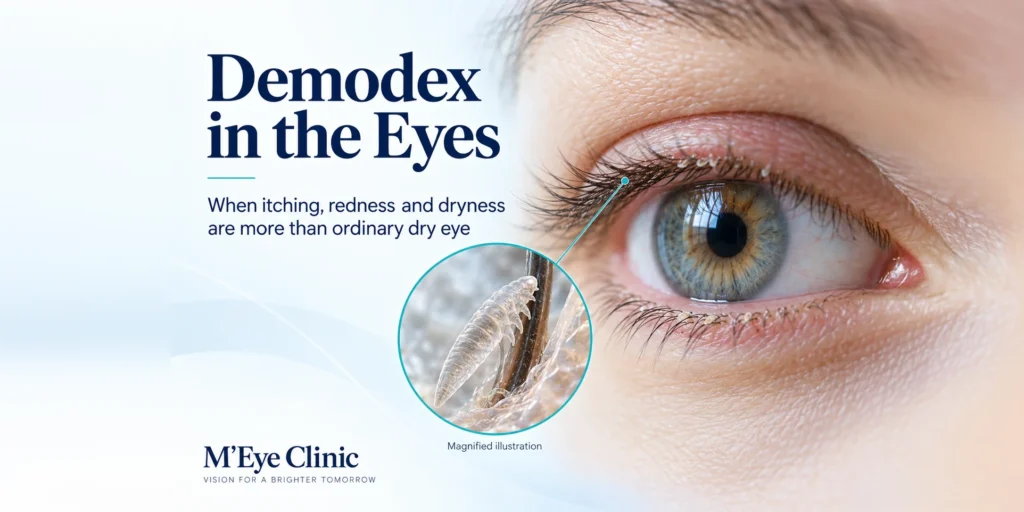
Itchy eyes, redness, burning, a sandy feeling and dryness are symptoms that many patients immediately connect with dry eye. Sometimes that is exactly what is happening. But in some cases, especially when symptoms keep returning despite drops, cleaning routines or changing contact lenses, the problem may begin at the eyelids and the base of the eyelashes.
One important cause to know in this context is Demodex in the eyes. Demodex is a tiny mite that can naturally live around the skin and eyelashes in many people. When there is an overgrowth, or when the eyelid area becomes irritated and inflamed, it may be associated with itching, blepharitis, redness, burning and dry eye symptoms.
The challenge is that many patients treat the eye surface itself, but the eyelids are not always examined carefully. When the source of the problem is at the lash line, another lubricating drop may not solve the real issue.
What is Demodex in the eyes?
Demodex is a microscopic organism that lives around hair follicles and oil glands. Around the eyes, it may be found mainly near the roots of the eyelashes and the eyelids.
In small amounts, it may not cause a noticeable problem. But when it increases, or when it contributes to irritation and inflammation around the eyelid, the patient may experience symptoms that feel very similar to regular dry eye.
This is one reason why it is not enough to ask only, “Do I have dry eye?” The eyelids, eyelashes and eyelid glands should also be part of the evaluation.
What symptoms may suggest Demodex?
Symptoms may vary from one patient to another, but several signs appear frequently:
- itching around the eyelids or lash line
- red eyelids
- burning sensation
- sandy or foreign body sensation
- crusting or debris around the lashes
- sticky eyelids in the morning
- dry eyes that do not improve enough
- sensitive eyes
- contact lens discomfort
These symptoms do not prove on their own that Demodex is present. They are warning signs that justify a professional evaluation.
Why can Demodex feel like dry eye?
The eyelids are an important part of the tear system. If there is eyelid inflammation, poor eyelid gland function or chronic irritation around the lashes, the tear film may become less stable.
When the tear film is unstable, vision may blur, the eye may burn, and the patient may feel the need to blink or use drops again and again. That is why Demodex can feel like dry eye, even when the main problem is not simply a lack of tears. If dryness keeps returning over time, it is worth learning more about dry eyes treatment and the different factors that can affect the front surface of the eye.
Why are eye drops not always enough?
Lubricating drops may relieve dryness temporarily. But if the source of the problem is inflamed eyelids, debris around the eyelashes or Demodex, the relief may not last.
It is a little like cleaning a window while the dirt is sitting in the frame. The view may improve for a moment, but the source of irritation remains.
In these cases, the evaluation should consider whether there is:
- blepharitis
- blocked or poorly functioning eyelid glands
- debris around the eyelashes
- typical crusting
- signs that fit Demodex
- a combination of dry eye and eyelid inflammation
Patients who wear contact lenses may feel this even more. When the eye is irritated, dry or inflamed, standard lenses may become less comfortable. If the discomfort is persistent, a broader evaluation such as a comprehensive eye exam may help identify whether the problem is coming from the lens, the tear film, the eyelids or a combination of factors.
How is Demodex checked?
A Demodex evaluation does not begin with guesswork. The eyelids, lashes, lash roots and clinical signs around them need to be examined closely. In some cases, characteristic buildup around the lashes, eyelid redness or signs of blepharitis may be seen.
The exam is especially important when:
- itching returns again and again
- dry eye does not respond well enough to regular treatment
- the eyes are red in the morning
- there is debris or stickiness around the lashes
- contact lenses have become difficult to tolerate
- dryness, burning and redness appear together
In these cases, a routine glasses prescription is not enough. The eye should be understood as a system: eyelids, tears, cornea, lenses and daily function.
What should be done when Demodex is suspected?
The first step is diagnosis. It is better not to start random treatment before understanding what is actually happening. In some cases, eyelid hygiene may be recommended. In others, more targeted management may be needed. Sometimes both dry eye and eyelid inflammation need to be addressed at the same time.
The right approach depends on the eyelid condition, the severity of symptoms, the patient history, contact lens use, tear film status and any additional eye or systemic conditions.
The goal is not only to calm the eye for a few hours. The goal is to understand the source of the irritation and improve comfort over time.
When can Demodex affect contact lens wearers?
Contact lens wearers are more sensitive to changes on the ocular surface. When there is eyelid inflammation, dryness or irritation around the lashes, the lens may feel less stable, less comfortable or more “dirty” during the day.
If you wear lenses and notice that comfort has decreased, that the lens becomes annoying after a few hours, or that the eye is redder at the end of the day, do not look only at the lens type. Sometimes the eyelids also need to be examined. In cases where regular lenses are no longer suitable, more advanced options such as scleral lenses may be considered in selected patients, especially when dryness or ocular surface sensitivity is significant.
How M’Eye Clinic approaches Demodex and dry eye
At M’Eye Clinic in Jerusalem, Israel, dry eye, itching and redness are not reduced to the question of which drops to use. The aim is to understand whether the issue is dry eye, eyelid inflammation, Demodex, contact lens intolerance, a corneal condition or a combination of several factors.
This approach can be especially relevant for patients from Israel and from the wider Middle East who have already tried drops or lens changes but still experience recurring discomfort.
FAQ
Is Demodex in the eyes dangerous?
In most cases, it is mainly associated with discomfort and eyelid inflammation, but it should be checked when symptoms are persistent. Diagnosis and treatment should be guided by a professional.
Can Demodex cause dry eye?
It may be associated with dryness, burning and discomfort, especially when eyelid inflammation affects the stability of the tear film.
How do you know if you have Demodex?
Not by symptoms alone. The eyelids, lashes and lash roots need to be examined for clinical signs.
Do dry eye drops treat Demodex?
Not necessarily. Drops may relieve dryness, but if the source is in the eyelids, the eyelid condition must also be addressed.
Can Demodex affect contact lenses?
Yes. Eyelid irritation and dryness may make lenses less comfortable and may increase burning or redness.
Summary
Itching, redness and dry eyes are not always caused by simple dry eye. When symptoms return, when drops are not enough, or when contact lenses become difficult to tolerate, the eyelids and lash line should also be checked.
Itching or dryness that keeps coming back? Leave your details below and we will get back to you.
Demodex in the eyes is one of the causes worth knowing about – not to create fear, but to avoid missing the right diagnosis. Sometimes the path to relief begins exactly where no one has looked closely enough: at the edge of the eyelid.