
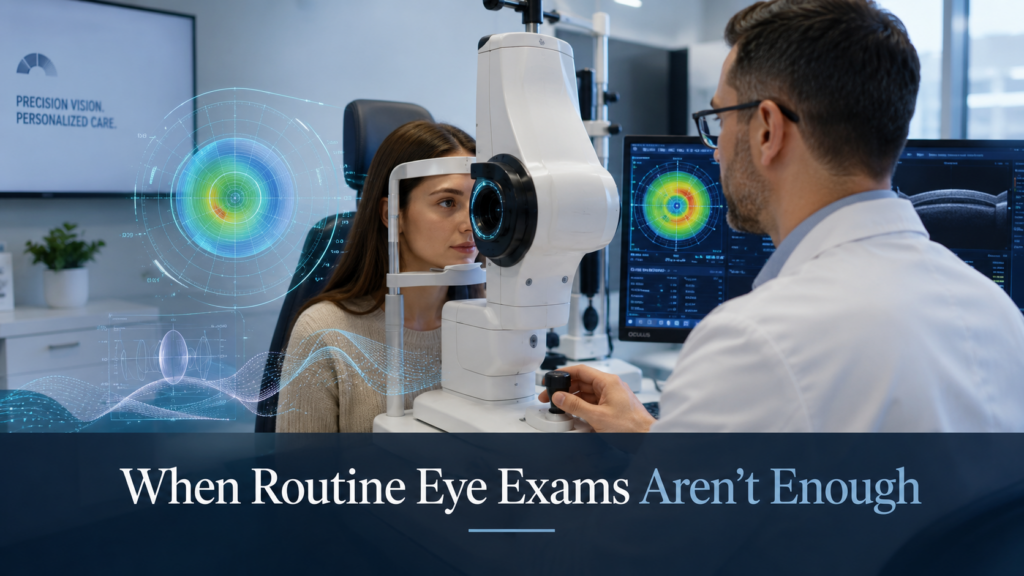
Most people assume that if they have had an eye exam, then their vision problem has already been fully evaluated. In many routine cases, that is true. If the main issue is standard nearsightedness, farsightedness, or astigmatism, a regular refraction may be all that is needed to improve vision and comfort.
But not every visual complaint fits neatly into that category.
There is a group of patients who leave routine eye exams with the same frustration they had before the appointment. Their prescription may be updated, the eye chart may look “acceptable,” and yet something still feels wrong. They may describe fluctuating vision, glare, halos, ghosting, unstable clarity, discomfort with contact lenses, poor night driving, or a feeling that their sight is technically present but never truly sharp or reliable.
This is where advanced optometric evaluation and comprehensive eye exam becomes important. It is not about repeating the same exam more carefully. It is about recognizing that some patients are not dealing with a simple prescription problem at all. They are dealing with a complex visual system problem.
What is a routine eye exam good at, and where does it stop?
A routine eye exam is extremely useful for common refractive issues. It helps determine whether a patient needs glasses, whether the current prescription should be adjusted, and whether obvious ocular changes need further medical follow-up.
But routine testing is not always designed to answer more complicated questions, such as:
- Why does the vision fluctuate during the day?
- Why is night vision much worse than daytime vision?
- Why do glasses improve the chart but not real-life function?
- Why does the patient struggle with contact lenses even after multiple attempts?
- Why does the image feel smeared, “dirty,” doubled, or unstable?
- Why is visual quality poor even when acuity looks relatively good?
In those cases, the question shifts from “What is the number?” to “What is actually degrading the image?”
Who typically needs advanced optometric evaluation?
- Patients with fluctuating vision
If vision changes from hour to hour or from morning to evening, the issue may be more than a standard refractive change. Fluctuation can be related to the tear film, the corneal surface, irregular optics, or a more complex interaction between comfort and image quality.
Patients often say:
- “Some days I see well, some days I don’t.”
- “The image gets worse as the day goes on.”
- “Blinking helps, but only for a moment.”
This kind of complaint deserves deeper analysis than a quick prescription update.
- Patients who are unhappy after LASIK or PRK
One of the most misunderstood groups is the post-laser patient who says, “I can see, but I still don’t see well.”
These patients may present with:
- halos
- glare
- starbursts
- nighttime driving difficulty
- unstable contrast
- dissatisfaction despite “good” acuity
Sometimes dry eye is the main factor. Sometimes the corneal shape has changed in a way that affects optical quality. Sometimes higher-order aberrations are involved. A standard refraction alone may not capture the real source of the complaint.
For this group, it often helps to understand how specialty solutions are used after surgery that did not deliver the expected functional outcome.
Related reading: Therapeutic contact lenses after failed laser surgery
- Patients with suspected keratoconus or irregular corneas
Not every patient with worsening astigmatism has keratoconus, but when vision is becoming less stable, less crisp, or harder to correct, the cornea needs closer attention.
This is especially true when:
- the astigmatism seems unusual or progressive
- the patient reports ghosting or shadowing
- glasses never seem to “lock in” clear vision
- contact lenses have become harder to tolerate or less effective
In these cases, advanced optometric evaluation can help determine whether the problem is simple refractive error or an irregular corneal shape that requires a different management strategy.
Related reading: Keratoconus treatment
- Patients with corneal scars or post-surgical corneal irregularity
A scar, transplant history, old trauma, prior surgery, or long-term corneal change can alter the way light passes through the eye. These patients may not just be “blurry.” They may have distorted vision, reduced contrast, or severe symptoms in difficult lighting.
What matters here is not only whether the patient sees the chart, but whether the cornea is creating a stable and usable image. When corneal shape and optics are part of the complaint, advanced evaluation becomes much more valuable.
Related reading: Corneal scars and HOA correction
- Patients with chronic dry eye and poor visual quality
Dry eye is often reduced to a comfort problem, but in many patients it is also a visual quality problem.
An unstable tear film can cause:
- fluctuating blur
- light scatter
- intermittent ghosting
- poor screen tolerance
- worsening symptoms late in the day
The challenge is that dry eye may be the whole story – or only part of it. Some patients have dry eye plus a deeper corneal or optical issue. That is why advanced evaluation can be so useful: it helps separate a surface problem from a structural or optical one.
Related reading: Dry Eyes Treatment
- Patients who have failed with regular contact lenses
A patient who “couldn’t adapt to contact lenses” does not always have a simple tolerance problem. Sometimes the real issue is that the eye was never a good candidate for conventional lenses in the first place.
This is common in:
- complex corneal shape
- post-surgical corneas
- severe dryness
- unstable optics
- patients who need a more customized fit than standard lenses can offer
When someone has already “tried everything,” advanced evaluation often changes the conversation. Instead of asking why the patient failed with ordinary options, it asks what kind of optical environment the eye actually needs.
Related reading: Scleral lenses
- Patients with prism or binocular complaints
Not every complex case is corneal. Some patients struggle because the two eyes are not working together efficiently. They may describe:
- eye strain
- headaches
- reading fatigue
- trouble focusing
- double or shadowed vision
- feeling visually exhausted despite updated glasses
These complaints may point toward binocular or functional visual issues that need a more detailed optometric approach rather than another simple refraction.
- Patients with any other eye disease/condition
So what does “advanced optometric evaluation” actually mean?
It means the assessment is built around the complaint, not just the prescription.
Instead of stopping after “what is the number,” the evaluation may explore:
- optical quality
- corneal shape and regularity
- surface stability
- visual fluctuation patterns
- previous surgical history
- contact lens history
- comfort versus function
- whether the problem is refractive, corneal, optical, or binocular
In practical terms, this kind of evaluation is often more useful for patients who say:
- “I’ve had exams before, but no one really explained the problem.”
- “My prescription is okay, but I still don’t function well.”
- “I know something is wrong, but I don’t know what to call it.”
Why this matters before choosing a treatment
Without the right diagnosis, treatment becomes guesswork.
One patient may only need better ocular surface management.
Another may need a different contact lens strategy.
Another may need a cornea-focused rehabilitation plan.
Another may need prism thinking or a more tailored functional approach.
But if all of them are treated as ordinary “number change” patients, they often stay stuck in the same cycle:
- new glasses
- partial improvement
- recurring frustration
- another opinion
- no real clarity
Advanced optometric evaluation is often the first step that breaks that cycle.
Where a center like M’Eye Clinic fits in
For patients with complex visual complaints, the value is not just in having more tests. It is in seeing a clinic that is already built around complex cases.
M’Eye Clinic in Jerusalem Israel positions itself around advanced visual rehabilitation, scleral lens fitting, keratoconus management, dry eye care, and specialty work for patients whose complaints go beyond standard refraction. Its English site clearly centers services such as scleral lenses, dry eyes, keratoconus treatment, and a broader comprehensive eye exam. That makes it a relevant example of the kind of place patients look for when routine care no longer explains what they are experiencing.
Also, at M’Eye Clinic, patients benefit from some of the most advanced diagnostic and imaging technologies available today in the field of cornea, specialty contact lenses, and visual rehabilitation. The clinic combines high-end technologies such as the Pentacam AXL Wave, Optovue SOLIX OCT, advanced wavefront aberrometry, EyePrintPRO impression-based scanning, and multimodal anterior segment imaging – all under one roof. Having access to this level of technology within a single private clinic is exceptionally rare, and allows for a far deeper, more precise, and more personalized evaluation of complex visual cases than what is typically available in standard eye care settings.
FAQ
Does needing advanced optometric evaluation mean something is seriously wrong?
Not necessarily. It simply means the complaint may not be explained by a standard prescription alone.
If I can read the chart, can I still have a real vision problem?
Yes. Good acuity does not always mean good visual quality or good visual function.
Is this only for keratoconus patients?
No. It can also apply to post-LASIK dissatisfaction, corneal scars, severe dry eye, failed lens wear, prism needs, and fluctuating vision, and many other conditions
Will advanced evaluation automatically mean I need specialty lenses?
No. Sometimes the conclusion is surface treatment, monitoring, or a different refractive strategy. The point is to understand the complaint accurately before choosing the next step.
When should I stop asking for “stronger glasses” and ask for something deeper?
When your symptoms persist despite updated prescriptions, especially if you feel your vision is unstable, low-quality, uncomfortable, or functionally disappointing.
Final thought
A routine eye exam is valuable , but it is not the end of the story for every patient.
Some people do not need stronger glasses. They need a better explanation. They need someone to identify whether the problem lies in the tear film, the cornea, the optics, the binocular system, or the gap between chart vision and real-world function.
That is where advanced optometric evaluation becomes so important. Not because the case must be rare or dramatic, but because the right diagnosis is often what finally makes the path forward clear.