
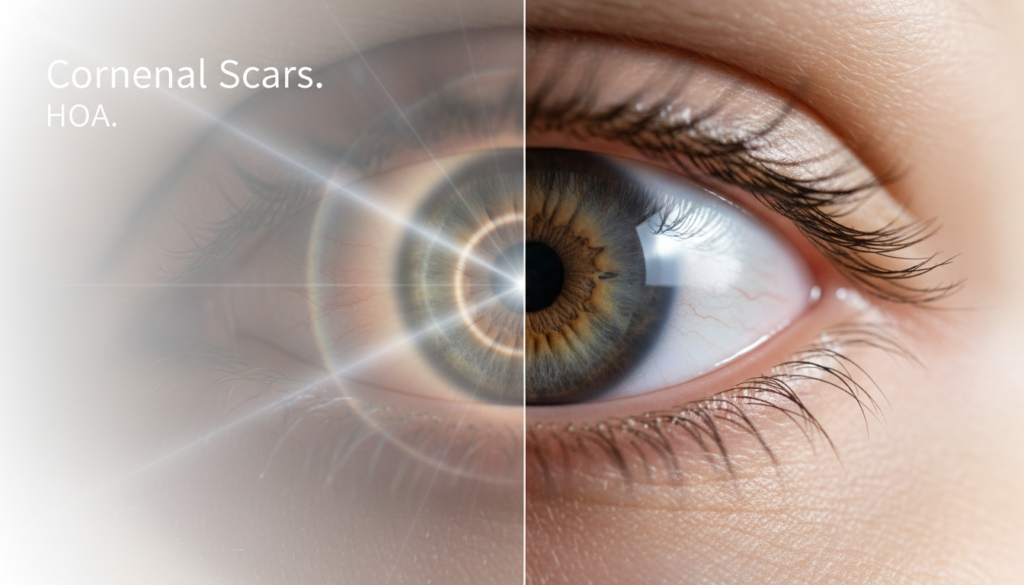
Corneal scars are among the most frustrating causes of reduced vision. They can result from injury, surgery, infection, chronic inflammation, ruptured sutures, using poorly fitted rigid lenses or severe cases of keratoconus. Many patients don’t realise that their poor vision isn’t due to “the wrong number” in their glasses but to deeper optical distortions caused by scar tissue.
Most standard eye examinations do not detect these distortions because they only measure sphere and cylinder. When patients receive new glasses or contact lenses repeatedly with little improvement, it can be discouraging. In reality, much can be done.
What causes a corneal scar?
Any injury to the cornea – the clear tissue at the front of the eye – can leave behind a scar that disrupts vision. Common causes include:
- Old injuries or trauma
- Infections such as corneal ulcers
- Chronic inflammatory diseases
- Laser surgeries (LASIK/PRK)
- Torn sutures after corneal transplantation
- Peripheral scars after deep anterior lamellar keratoplasty (DALK) or penetrating keratoplasty (PKP)
- Scars from old‑generation rigid lenses
- Irregularities from advanced keratoconus
- Extreme ocular dryness (for example in Sjögren’s syndrome)
These scars not only block light but also create high‑order aberrations. The result: blurred, hazy vision that glasses cannot fix.
Symptoms suggesting HOA rather than prescription error
Patients often report:
- Persistent blur that doesn’t improve with glasses
- Halos around lights
- Severe glare from headlights at night (starburst effect)
- “Dirty” or unstable vision
- Vision that changes throughout the day
- Eye fatigue when reading or working
- Difficulty driving at night
- Good acuity yet poor visual quality
Hearing phrases like “I’ve bought four pairs of glasses and still can’t see clearly” or “I tried scleral lenses but the vision wasn’t good” is common. These are classic signs of HOA.
What are high‑order aberrations?
High‑order aberrations are optical distortions beyond simple sphere and cylinder. They include coma, trefoil, spherical aberration and irregular astigmatism. They cannot be corrected with glasses, soft lenses or sometimes even ordinary rigid lenses. Measuring them requires advanced instruments like aberrometers. At M’Eye Clinic we use wavefront analysis and tomography to map and quantify these aberrations.
How does a scar create HOA?
The cornea must be smooth and transparent for light to focus properly. A scar, even a small one, disrupts the smoothness of the corneal surface and redirects light in abnormal ways. This produces halos, glare and blurred images. In advanced keratoconus, scars also create geometric distortions that worsen HOA. Sometimes HOA appear even without visible scars.
How we improve vision
- Precise measurement of distortions. We use advanced devices (such as wavefront aberrometers) to measure the exact pattern of aberrations.
- Custom lens design. A special rigid lens – often a scleral lens – is made with a front surface engineered to neutralise the specific aberrations measured. It is not a “standard lens” but a bespoke device designed to counter the optical distortions created by the scar.
- 3D impression and EyePrintPRO. For irregular scleral or corneal shapes, we may take a 3D impression of the eye to create an EyePrintPRO lens that fits perfectly and provides the best optical surface.
- Creating a new optical surface. The lens essentially gives the eye a new front surface – smooth, clear and accurately shaped – restoring a clean wavefront and high-quality vision.
Why M’Eye Clinic is unique
Most optometrists and ophthalmologists do not have the equipment to measure HOA or manufacture HOA-correcting lenses. Our clinic is the only one in Israel and the Middle East equipped for true clinical HOA corrections. We combine high‑end wavefront technology, specialised software for lens design and collaboration with custom labs (many of them in the USA) to deliver these solutions.
Who benefits from HOA corrections?
Anyone with optical distortions that are not fully corrected by glasses or standard lenses can benefit, including:
- Scars after infections
- Scars after LASIK/PRK
- Scars after corneal transplantation
- Old injuries
- Irregularity after CXL
- Keratoconus with scarring
- Complex irregularities not listed here
Many patients come to us after failed laser surgery or repeated unsuccessful fittings elsewhere and discover that the cause of their poor vision is HOA. With proper diagnosis and custom lenses, significant improvement is possible.
What does vision feel like after HOA correction?
Patients describe a sharper, cleaner view; halos and glare decrease dramatically; night driving becomes comfortable again; vision remains stable throughout the day; and overall quality of life improves. Comments like, “I thought I would have to live with this forever, but there was a solution” are common.
Frequently asked questions
- Do glasses correct HOA? No. Glasses cannot correct high‑order aberrations because the lens sits too far from the eye. Even so‑called wavefront spectacles cannot achieve the precision of a lens that sits directly on the eye.
- Can surgery fix HOA? In most cases no; surgery can actually introduce new aberrations. Only clinicians experienced with HOA will advise properly.
- Can a corrective lens help if I have bumps on the sclera? Yes. In such cases we design an asymmetric lens or incorporate EyePrintPRO to accommodate pingueculae or other scleral irregularities.
- Is it possible to fit a lens when there are several scars? Yes. In complex cases HOA correction provides the greatest benefit. Expect a thorough evaluation and careful discussion of anticipated results.
Conclusion
Corneal scars can dramatically impact vision, but they are not a life sentence. By measuring high‑order aberrations and creating customised correction, we can restore visual quality lost years ago. M’Eye Clinic is the only centre in the region equipped to perform these clinical HOA corrections. If your vision remains blurred despite wearing the “correct number”, you may have high‑order aberrations. Schedule an evaluation – there is a solution