
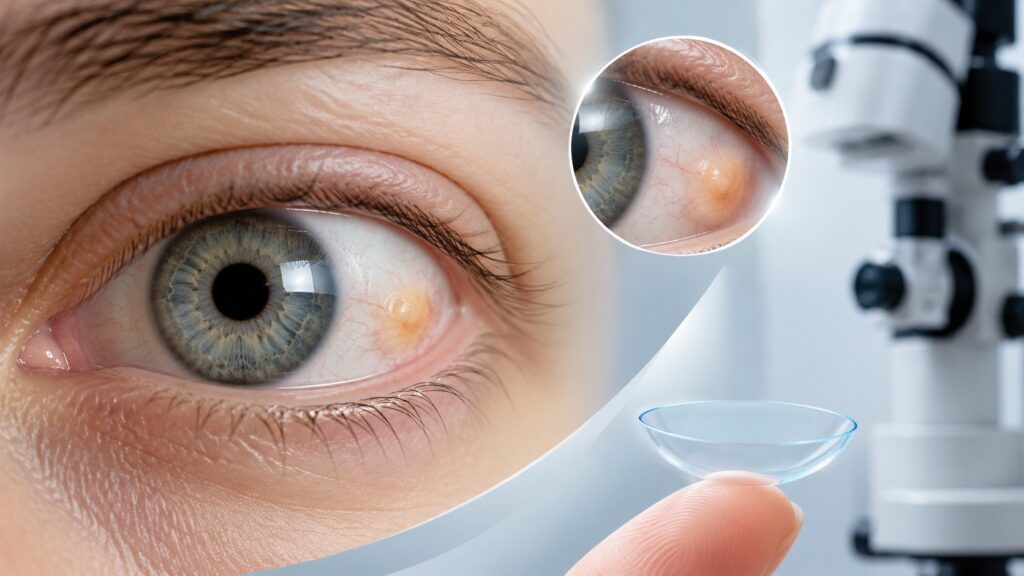
A pinguecula is often treated as a small cosmetic finding: a yellowish or transparent bump on the white of the eye. For many people, it causes little concern. But for patients who need specialty lenses, especially scleral lenses, a pinguecula can become a serious fitting challenge.
The reason is anatomical. A scleral lens rests on the white part of the eye, not directly on the cornea. If that landing area is uneven because of a pinguecula, bleb, scar or other bump, the lens may press, shift, irritate the tissue or fail to sit symmetrically.
What is a pinguecula?
A pinguecula is a small area of tissue on the conjunctiva, often related to long-term UV exposure, dryness, wind or chronic irritation. It is usually not dangerous, but it changes the surface where a scleral lens lands. In inflamed or dry eyes, the bump may become more sensitive. When a lens is not designed around it, patients may experience redness, burning, pressure or reduced wearing time.
How pinguecula affects scleral lenses
- The lens may press directly on the bump
- Blood vessels may become compressed
- The edge may lift or move
- The lens may not center properly
- Vision may fluctuate during the day
- The patient may need to remove and reinsert the lens repeatedly
For patients with keratoconus, post-transplant corneas, corneal trauma or previous failed fittings, even a
small scleral irregularity can make the difference between success and discomfort.
What patients feel when the lens collides with a bump
Common complaints include a recurring red spot, localized soreness, itching, fogging, lens awareness, or comfort that worsens after a few hours. Some patients assume they cannot tolerate scleral lenses, when the real issue is that the lens was not designed to respect the shape of the sclera.
How advanced fitting can help
In complex cases, the solution may involve asymmetric design, a localized vault, a notch, quadrant-specific landing zones, 3D scleral mapping or an impression-based approach such as EyePrintPRO. The goal is to design around the obstacle rather than forcing the lens to press over it.
Related service: EyePrintPRO.
Can pinguecula be removed?
Surgical removal is not always recommended, especially when the purpose is only to improve lens fitting. Surgery may create scarring, and the area may still not become smooth enough for a conventional lens. The decision must be made medically, case by case.
What if there are several bumps?
Multiple elevations or asymmetric scleral shape can still be managed in selected cases, but the fitting must be more customized. Standard lenses are often not enough when the landing surface is highly irregular.
M’Eye Clinic in Jerusalem, Israel
M’Eye Clinic in Jerusalem, Israel, evaluates complex scleral shapes in patients who need specialty lenses but have bumps, pinguecula, scars, post-surgical changes or previous fitting failures. The focus is to understand the surface anatomy and choose a design that improves comfort, stability and wearing time.
FAQ
Is pinguecula dangerous?
Most pingueculae are not dangerous, but they can interfere with scleral lens comfort and stability.
Can I wear scleral lenses with pinguecula?
Often yes, but the lens may need a customized design to avoid pressure on the bump.
Does pinguecula cause redness with lenses?
It can. Redness may appear when the lens presses on the bump or surrounding tissue.
Is EyePrintPRO useful for pinguecula?
In complex cases, impression-based or highly customized fitting may help design the lens around irregular scleral anatomy