
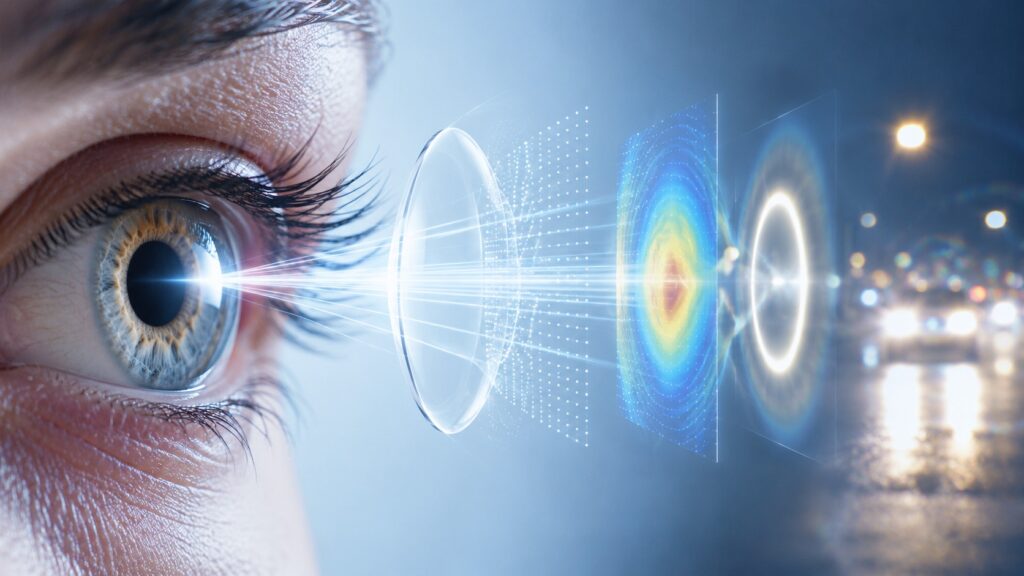
Some patients receive well-made lenses, updated prescriptions and careful standard fitting – yet their vision still does not feel clean. They may describe halos, glare, starbursts, ghosting, poor night driving or “dirty vision.” In many of these cases, the problem is not that the lens is bad. The problem may be that the eye has optical distortions that ordinary correction cannot fully neutralize.
These distortions are known as Higher Order Aberrations, or HOA. They are more complex than ordinary nearsightedness, farsightedness or regular astigmatism. They can affect the quality of the image even when visual acuity on the chart seems acceptable.
What are Higher Order Aberrations?
Standard refractive errors are usually corrected with sphere and cylinder. HOA are different. They involve more complex distortions in the way light travels through the eye. Common examples include coma, trefoil and spherical aberration. These aberrations can appear after corneal surgery, in keratoconus, after trauma, with corneal scars, or in highly irregular corneas.
What do HOA feel like?
- Halos around lights
- Starbursts from headlights
- Glare that feels stronger than normal
- Ghost images or shadowing
- Reduced contrast
- Night driving difficulty
- Vision that is “not sharp” even with correction
The most confusing part is that a patient may read the chart well in a bright room. The issue often becomes much worse at night, when the pupil expands and more peripheral optical distortion enters the visual system.
Why standard lenses may not be enough
A regular lens can correct the basic prescription, but it may not correct the higher-order optical distortion. This is why some patients feel that the number is correct, yet the quality is still poor. They may keep changing glasses or contact lenses, only to experience the same symptoms again.
HOA and scleral lenses
Scleral lenses can help many irregular cornea patients by creating a smoother front optical surface. However, even a well-fitted scleral lens may not eliminate all HOA. In more complex cases, the front surface of the lens may need to be designed specifically to address the measured aberrations.
This is where advanced HOA correction becomes relevant. Related reading: corneal scars and HOA correction.
When should HOA be suspected?
HOA should be considered when the patient has persistent visual quality complaints that do not match the standard prescription. This is especially relevant after LASIK or PRK, in keratoconus, after corneal grafts, after trauma, with scars, or when previous lens fittings produced comfort but not clear visual quality.
How are HOA evaluated?
Evaluation may include corneal topography, tomography, aberrometry and assessment of the visual complaint under real-life conditions. The goal is to identify whether the problem is refractive, corneal, tearfilm related, lens-related or a true higher-order optical issue. Why patients are often told “nothing more can be done”
HOA are not always detected in a routine refraction. If the clinic is focused only on acuity and prescription, the deeper optical issue may remain invisible. Patients then hear that the lens is “good,” even though they still cannot function comfortably. For these patients, the question is not only how well they see the chart. It is how clean, stable and usable the image is in daily life.
M’Eye Clinic in Jerusalem, Israel
M’Eye Clinic in Jerusalem, Israel, works with patients whose visual quality remains poor despite standard correction. In selected cases, advanced scleral lens fitting, wavefront analysis and HOA-guided strategies may be considered to improve the quality of the image rather than simply changing the number.
FAQ
Can glasses correct HOA?
Usually not fully. Glasses correct standard refractive error but are limited when the cornea or optical system creates complex distortions.
Can HOA exist even with 6/6 vision?
Yes. Visual acuity may be acceptable while visual quality remains poor, especially at night.
Are HOA only caused by LASIK?
No. They can also appear with keratoconus, corneal scars, trauma, transplants and irregular corneal surfaces.