
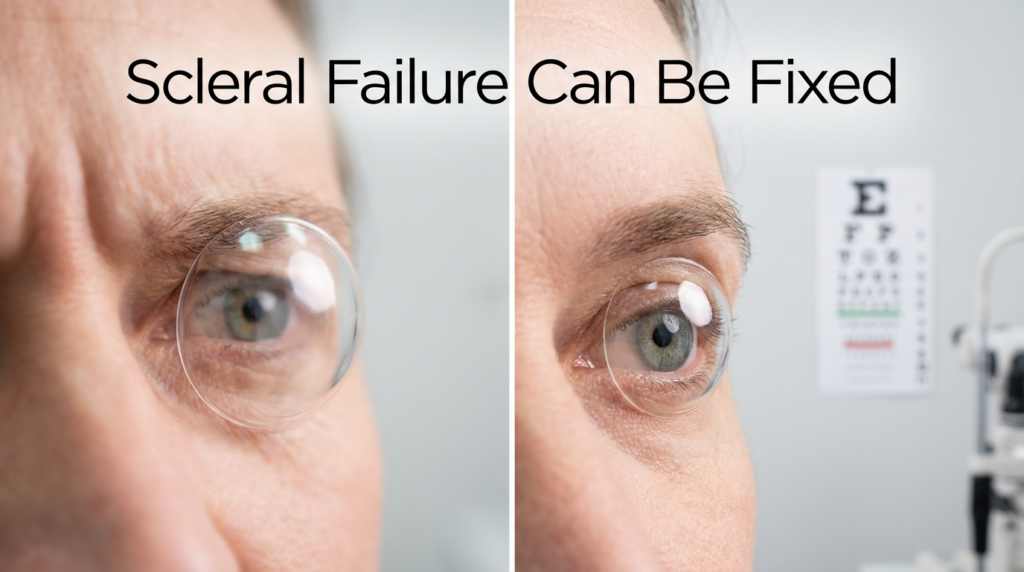
The short answer: failures with scleral lenses are common, and most of the time they are not the fault of the patient. They result from lenses that were not fitted properly, the wrong lens design for your eye or insufficient guidance during the adaptation period. In many cases, a new approach or a different technology can turn failure into success.
“I tried scleral lenses and it didn’t work” – a sentence we hear often
Many patients come to our clinic after an unsuccessful first experience:
- Discomfort
- Blurred vision
- Eye fatigue
- Frustration
They assume that if it didn’t work once, scleral lenses simply aren’t for them. That conclusion is often premature and can cause them to miss a life‑changing solution.
Common causes of scleral lens failure
- Midday fogging – a common phenomenon where particles accumulate in the fluid under the lens or debris adheres to the lens surface. Solutions: deeper understanding of the ocular surface to improve lens clearance and edge profile; changing lens material; adding hydrophilic coatings; changing the care regimen; and addressing ocular surface disease first.
- Lens discomfort. Standard designs may not suit complex anatomy: scleral irregularities, asymmetric corneas or post‑surgical eyes. In such cases, advanced designs and experienced fitters are required.
- Air bubbles under the lens. Bubbles cause blur, burning and instability. Sometimes the insertion technique is the problem; sometimes the lens design requires modification.
- Difficulty inserting or removing lenses. Many patients don’t receive sufficient instruction or support. They need time and practice to master the technique and must have someone to answer questions during adaptation.
When should you consider an alternative?
There are rare situations where scleral lenses truly aren’t the right choice:
- Severe oxygen transfer problems in high-risk corneas.
- Specific corneal diseases not amenable to scleral lens wear.
- Active ocular conditions where the eye is changing (for example, shortly after corneal transplant or during an immune flare).
- Rare allergies to lens materials (there are tests for this).
In such cases, a careful medical decision is needed rather than pushing a lens that may not be suitable.
Frequently asked questions
- If I failed once, is it worth trying again? Often yes, particularly if the previous attempt did not involve advanced fitting or proper follow‑up.
- I tried multiple times without success – should I give up? Not necessarily. The field has advanced; complex eye shapes that could not be fitted in the past often succeed today.
- Does failure mean my cornea is “too problematic”? Not necessarily. Many times the problem lies in the sclera (the white part where the lens sits) rather than the cornea. A customised, asymmetric design can solve this.
The most important message
Failure with scleral lenses is not a verdict. It may simply mean you need a different approach, a different technology or a truly specialised clinic. At M’Eye Clinic we analyse every case individually, using impression-based and wavefront-guided designs if necessary and providing thorough training and follow-up.
Don’t give up because of one bad experience. Contact us to learn how we can transform your scleral lens journey.